

We have had the pleasure of studying death and mourning practices with the following artists. Mortem began in 2018 as a weeklong intensive death themed research residency outside of Ottawa, hosted by the Ayatana Artists' Research Program and became a two-week online death school for artists with the Biophilium. It has always been an opportunity for artists to pursue our curiosity of mortality, mourning and the death care industry and enables residents to explore and develop our identities as death-curious artists. The residency initially involved lectures and field trips with experts who regularly work within the context of death, dying and mourning and learned about a range of death related topics. We met death doulas, embalmers, taxidermists, forensic anthropologists, green burial advocates, death care and funeral industry workers and artists who shared their unique relationships with and perspectives of death. Ashley Czajkowski participated in the first ever Mortem field residency and has participated as an expedition and research leader ever since. Mortem moved online in 2020 and transformed into an anual 2 week webinar with lectures from the international death positive scene and historical societies to facilitate talk about death. It's a supportive environment intended to help artists identify as mortals who make art about themes of death. It continues as a place for creative people to share tools, to talk about our work and to get involved with non-art professionals who also work with death. In 2023 Mortem continued as a Death Club, a monthly Death Cafe for artists that featured the creative mourning rituals of Biophilium alumni. In 2026 Mortem specialized in three directions. Undertake: Practical Death Care for artists, Nature Morte: Natural History of Death and Mortology: Anthropology of Death were born. |
|||
|
|||
Alexis Williams, Ottawa As an artist whose work is always expressing the value of life and living systems, the taboo against death as a conversation topic has not stopped Alexis from contemplating mortality in her performance, lab, wildlife photography and studio work. Everyone can do it, but artists have a particular advantage as practiced creative players: we have a profound freedom to invent mourning rituals and regularly renegotiate our relationships with the dead, which Alexis celebrates and encourages in others. She is curently making sacred objects whose sole purpose is to reveal the magic in all mater, living or dead and the devine in every moment, banal or ceremonial.
|
|||
I am a settler in Canada of Ukrainian, Baltic, Mennonite and Irish heritage. My work revolves around climate crisis endurance exercises that respond to climate uncertainty, land-use changes, and biodiversity loss with sensual research, ecological materials, reciprocal pigment foraging, other-than-human invitations, climate narratives, and socially-engaged ecoart practices. Living within the territory of the Atikameksheng Anishnawbek in N'Swakamok (Sudbury, Ontario), I recognize that colonialism and mining interests led to the creation of the Robinson Huron Treaty of 1850. Mining impacts directly effect the context in which I work, including the tensions among fallout of historical nickel smelter pollution, heavy metal levels, mass tailings ponds, as well as an immense community-engaged regreening project remediating the land through the re-alkalizing and planting of 10 million trees, described in my personal and collective work as part of ee portal. My current projects are soil colour carbon sink, bog-moss-lettuce, and sounds are pigments are places, funded by the Canada Council for the Arts and Ontario Arts Council. |
|||
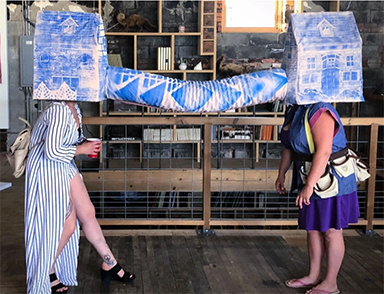 Elise Martin, Detroit, MI My studio practice combines fiber arts, sculpture, and installation to explore themes of empathy, comfort, care. Through slow handcraft processes, I often transform familiar reclaimed materials into immersive environments and interactive sculptures that invite viewers into experiences of vulnerability, connection, and reflection. Much of my work emerges from my own experience as an empath and introvert, navigating a world that often feels increasingly disconnected and imbalanced. I use art as a means of making tangible the emotional labor and societal influences that shape our relationships with our communities, the land and ourselves.
|
|||
Afuwa, Vancouver, BC don’t be afraid of the dark forest. just know that some things are not meant to be understood. have faith in the machete, and be strong in your heart/mind. look back often, but go forward always, until you can go no more. you are never alone. |
|||
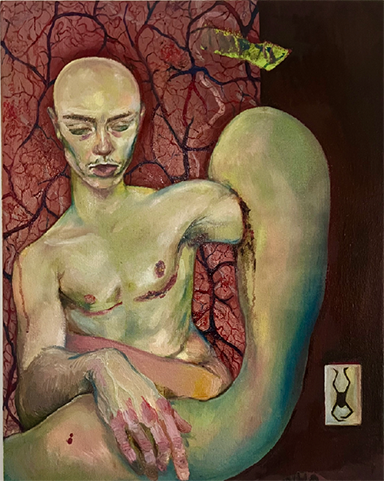
Having graduated with an MA in Fine Art at Central St Martins, London, UK in 2024, Bristow continues to untangle grief, curiosity and queerness through a multi-faceted, regurgitating practice. Bristow’s sculptures in particular are concerned with the organic decomposition of the body as a source of power. A reverse ‘becoming’ that challenges the constraints of Late Capitalism through mess and re-articulation. Bristow’s sculptures are thought of as corpses in their own right; created by the Artist as stand-ins for the body of his brother, who he lost in 2018 and who’s body he was unable to care for. The notion of ‘stuck’ grief is explored through sculptures with their own disrupted life spans, being destroyed, re-worked and reinstalled; forming their own cyclical death. Bristow’s paintings grapple with a sickly pallet of rich greens and pinks whereby self-portraits render a small death for the Artist, one that represents transness and organism transgression with equal concern. His Essay ‘Can the Corpse Speak’ which was published in 2024, posits the decaying body and the trans body alike as historically repressed instigators of a world liberated from value through a fixed image of the body. Now living in Toronto, Canada and working without a studio, Bristow is returning to painting, graphite, and poetry disseminating various symbols such as keys, iris-less faces and found text through each medium, building a self-feeding world where grief feels safe to access, and loss is fragmented into measured chunks of creation.
|
|||
Gabrielle Mulholland, Brooklyn, NY / Montreal, QC |
|||
My artwork strives to be comforting, healing, and helpful. It is part joy, part catharsis, and always seeks the sublime. A recurring theme in my work is Love and Loss. Over the years, I have developed a series of small sculptures with a focus on healing. I think of the objects as talismans; objects that give strength or bring luck. They are a balm for things that have no cure. They are tiny tools for finding peace. Combining and altering personal objects that I have collected is how I make much of my work. Many of the materials in my sculpture are the debris from medical treatment: the vials that medicine comes in, the glass tubes from syringes, and pills. Those objects can have a negative connotation. They allude to illness, pain, and uncertainty. As a means of coming to terms with that uncertainty, I embrace those healing objects; I make them silly, I make them beautiful. I combine them with rocks, flowers, toys, and other objects to bind them to the mundane of everyday. All the components of the work have been touched, used, loved, and worn; any clinical cleanness and intimidating newness has been rubbed off. The artworks are as whimsical as they are weighty. |
|||
Miranda Newman, Toronto, Canada I’m a bestselling award-winning nonfiction author (ROUGH MAGIC, McClelland & Stewart, 2024) and journalist whose work focuses on psychology, identity, healthcare, disability, and lived experience. My artistic practice is driven by the idea that personal narratives and concise reporting can demystify complex human realities and transform isolating experiences into shared and nuanced opportunities for connection. I work within the intersection of literary arts, healthcare advocacy, and trauma-informed community building. My creative environment is shaped by my identity as a queer, disabled writer. I’m committed to producing work that reframes culturally challenging subjects like grief, death, and trauma through nuanced, accessible, and socially engaged nonfiction. My artistic practice grapples with systems of care and harm, from psychiatry to palliative care, and is deeply informed by my role as both a writer and peer support provider within communities that experience marginalization and medicalization. “The End” will be my second essay collection. The research-intensive structurally ambitious nonfiction collection will combine memoir, journalism, and cultural criticism to explore topics like what we can learn about death acceptance from Ukrainian cultural rituals and attitudes, the bureaucratic systems surrounding dying and its role in grief, and dying in a society that prioritizes productivity. |
|||
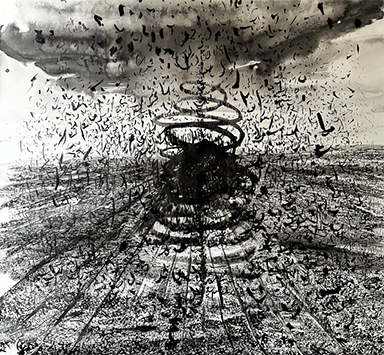
Bedia Ekiz was born in the rich ecological and biological landscape of Çukurova, characterized by its volcanic cones and leached soils. She establishes a deep connection with her personal roots shaped by the mystical historical texture of this region—ancient Anatolia, mythologies, and a nomadic-pastoral lifestyle. The region’s archaeological mounds, ancient stories, bird sanctuaries, and ecological richness form the foundation of her profound explorations into human nature and existential traces. Drawing from her personal witness and the expression of primal pain, Ekiz approaches urban habitats and the rewilding of the “three hills” through a philosophical, psychoanalytic, sociological, ecological, and spiritual perspective. Her artistic practice is centered on examining the existential relationships of human beings and the notion of psychogeography. She documents these experiences through performance videos, sound collages, interactive objects, sketches, and scents. In her studio, she immerses herself in these sources, engaging deeply with their technical and research-based dimensions. Alongside primitive materials such as paper, ink, and charcoal, she adopts a multidisciplinary language that |
|||
Marcy Askari, Tehran, Iran |
|||
I am a poet, not a naturalist, but my poetry often creates a “map” of a place, incorporating geography, geology, archeology, ecology, natural history, memory, and perception. I am interested in borders, what earthworks artist Robert Smithson calls “The Slurb,” the collision between the human made and the wild.
|
|||
Klaire Doyle is an interdisciplinary artist and art educator from Northern England.
|
|||
| Klaire | |||
Kri Van Sloun, Cincinnati, OH I'm a textile and wood sculpture artist focusing on world building utilizing biography, personal mythology and lore. I've been volunteering with hospice since October of 2025 and am one of the facilitators for Cincy Death Club.
|
|||
I am a writer, musician, and visual artist living and working in my home state of Colorado.
|
|||
“When I am a hundred and ten, everything I do, be it a dot or a line, will be alive. “. Katsushika Hokusai |
|||
|
|||
I am a queer, trans-non binary emerging artist. I was born and raised on the East coast. I work in many different mediums; including textile, ceramic, tattoo, drawing, painting, silver, leather, and printmaking. I like telling stories through imagery, dyeing, textures, and shapes, as well as the material I use, which is almost exclusively recycled and upcycled material. I am currently turning my focus to my textile and fibre practice. |
|||
My practice investigates how images shape—and distort—our sense of reality. Both my dyslexia and my queerness inform the working methods: language is approached visually, perceiving words as shapes and time as layered rather than sequential. This temporal logic runs through a hybrid practice, where photography, film, drawing, performance, sound objects and installation intertwine. By subverting the use of language, the act of writing and (optical) media, the work reveals the glitches, layers, and temporal shifts hidden within them. |
|||
My work explores grief as a response to change: the evidence that something mattered, something shifted, and we were changed by it. |
|||
|
|||
Alexis Williams, Ottawa As an artist whose work is always expressing the value of life and living systems, the taboo against death as a conversation topic has not stopped Alexis from contemplating mortality in her performance, lab, wildlife photography and studio work. Everyone can do it, but artists have a particular advantage as practiced creative players: we have a profound freedom to invent mourning rituals and regularly renegotiate our relationships with the dead, which Alexis celebrates and encourages in others. She is curently making objects whose sole purpose is to reveal the magic in all mater, living or dead and the devine in every moment, banal or ceremonial.
|
|||
The human relationship with nature is a tenuous one. We are at once a part of the natural world, yet intentionally set apart from it. I am interested in this disconnect; our refusal as a species to admit that we, too, are animals. There is a sense of savagery that comes with being an animal, being wild. We have been taught to become something other, to become domesticated. There is loss in this becoming. Though all experience this (false) dichotomy between humans and nature, the accepted social construction of femininity is much further removed from the nature of the human animal. |
|||
I am a poet, not a naturalist, but my poetry often creates a “map” of a place, incorporating geography, geology, archeology, ecology, natural history, memory, and perception. I am interested in borders, what earthworks artist Robert Smithson calls “The Slurb,” the collision between the human made and the wild. |
|||
Ellis is an Albertan born artist who has an ongoing love affair with botanical poison. She studies, documents and seeks out poisonous plants that can be found growing naturally within the province of Alberta. Through the process of her work, she studies the relationships between plants and people, and the dependence one has on the other. |
|||
In my photographic art practice, I look for the uncanny and embrace mistakes to offset my default tendency that leans toward perfectionism.
|
|||
Adrienne Defendi, Palo Alto, CA Adrienne Defendi is a multimedia artist whose work explores the cyclical, the ephemeral, and the fragility of life. Her lifelong interests in memory, narrative, and materiality inform her photographic expression and artistic process. Employing different mediums, from analog to alternative processes and various printmaking techniques, her practice charts elements of loss and ritual, and the boundless possibilities within reiteration and experimentation. Adrienne lives and works in the San Francisco Bay Area. |
|||
It begins in poetry and expands out into orality, music, movement, multimedia, film and fiction. |
|||
Vivekananda Kadakam Ramakrishna, Mangalore, Karnataka, India For me, art is a continuum—a tapestry woven together with research, personal memory and responsive performance, where something new enters the world by extending what already exists. I was raised by women across three generations, with a steady diet of oral stories that taught me how to live inside many worlds at once. Those stories showed me that the dead are not gone, but they persist in gestures, rituals, land and voice.
|
|||
I make work to open spaces for humans to feel what we avoid–– grief, awe, complexity, even dread. I use natural materials, sound, and time in works that range from installation to photography. I think of the work as a vessel for human difficulty because I believe the avoidance of such difficulty is responsible for violence and disconnection. Creating an experience that touches and allows someone to process whatever in themselves |
|||
|
|||
Arianna Tinulla Milesi, Leicester - UK and Toscolano Maderno - Italy Drawing is my way of seeing and interpreting the world as a perpetual work in progress.
Rooted in the living structure of the line, my practice explores how perception, emotion, and knowledge intertwine.
My research spans seaweeds, coping mechanisms, devotional art and syncretism, memory, vulnerability, gender-based violence, and death. I draw inspiration from art history, fashion, anthropology, science, music, and literature, creating suspended, osmotic atmospheres where ideas can be reimagined through unexpected associations. My visual language is layered and dreamlike, built on intuitive juxtapositions and open dialogue. I often collaborate with artists, researchers, and musicians, creating live paintings and interactive installations with recycled and natural materials, graphite, ink, pigments, edible and biodegradable elements. Since 2025, I’ve been developing bioplastics from seaweed and experimenting with wearable drawings on textile surfaces. I aim for works that feel light, intimate, and graceful, believing in tenderness as radical strength and connection as political resistance. In my workshops, I teach drawing as a cognitive and empathic tool to foster awareness, imagination, and wellbeing. Ultimately, my practice is an invitation, a matryoshka of stories and perspectives where everyone is welcome |
|||
“Renée Magañas oeuvre resembles a virtual cemetery. But a cemetery that one visits with pleasure. Death and transience are indeed woven into all her art. Her work is colorful and cheerful, combining the child's casual curiosity with the adult's experience of loss, sensitive remembrance with subtle cheerfulness.” As a half-Mexican living in Switzerland for several decades, my artistic work deals with the different ideas and significances of death in different cultures. In Mexico, death is not a taboo, but often the subject of an ironic debate that is reflected in the light-hearted representation and form of skeletons, among other things. Death has a high value in various Mexican traditions. My artistic practice does not distinguish between my daily life and my artistic interests. I am inspired by memories, triggered by different incidents: a smell, a photograph, an environment, a sound, the light, a film. I have been collecting, researching and preserving things dead or relating to death – as an artist and as a private person – for several decades. I collect the overlooked, the left behind, the lost or forgotten. It is a fascination for discovery in the old and the used and how I can transform them in order to present hidden stories they might have to tell. |
|||
Klaire Doyle is an interdisciplinary artist and art educator from Northern England.
|
|||
Ellie Ryan, Halifax Nova Scotion Following the deaths of a best friend and two close family members when I was twelve years old, I noticed the people around me were reluctant to answer the questions I had around death and dying. In the search to answer the question of what happens as we die. This trauma informed artistic exploration of death has defined both my personal and professional practice and is woven into the projects that I create. |
|||
Tate Obayashi, New York City, NY When my father suddenly passed away in January of 2020, I put my career as a prop designer in New York City on hold. Then the pandemic hit. During this tumultuous time, filled with both personal loss and global tragedy, death was at the forefront of my mind—it consumed me. As I searched for an urn for my father, I found that most options on the market were stark reminders of his absence. Austere, traditional and lacking in personality. I wanted an urn that celebrated my father for who he was: charismatic, humorous, and, perhaps, a little flawed. Something that reflected a life well lived. Having used creativity as a coping mechanism for much of my life, it felt only natural to channel my grief into art. After several years of development, I’ve created a collection of ceramic deathware – urns, altars, amulets and ceremonial objects under the name Bad Days. Drawing inspiration from ancient burial traditions, Victorian memento mori, and Japanese design, each piece is meticulously hand-sculpted from clay, then glazed in vivid colors, and at times adorned with semi-precious stones and leather. Every piece fits right at home while still honoring a dearly departed loved one. |
|||
Star’swork focuses on cosmic communication and the personal encounters and discussions she collects from her experiences.
|
|||
As a mixed media artist, I create collages and assemblages with paint, paper, fabric, vintage family photos, and found objects. My work is a dialogue between memory and imagination, often weaving personal history with universal symbols. I am inspired by old and abandoned places, the moon and stars, quiet cemeteries, and the changing seasons — spaces and moments where time feels both suspended and fleeting. People often ask why I use skulls and skeletons in my work. Growing up on a farm and woodland area in the 1970s, it was not uncommon to come across the bones and skulls of different animals — it was simply part of the landscape. That early familiarity made skulls feel natural to me, not morbid. Today, I use them as symbols and reminders: we all share the same fate. This awareness, far from grim, is a powerful invitation to truly live. For me, skulls aren’t about death—they’re about cherishing life. Memento Mori! My artwork has been featured in creative publications, and my self-published collage books are available on Amazon.com. Learn more and sign up for my monthly artsy updates at StrangeFarmGirl.com.
|
|||
Lilie Emblem, Montreal
|
|||
Gizeem Canden, Montreal, My work explores the intricate relationship between the human figure and landscape and reflects on the themes of anxiety, precious life, death, and rebirth using multidisciplinary approaches such as painting, foraged pigments, biomaterials, and video. As a form of alchemical transformation, raw materials undergo a metamorphosis and create a field for healing both the body and the mind. I capture the intersection of the tangible world and the inner emotional stage by reimagining the hidden stories of employing water and soil as a symbolism of renewal. By embracing the conflict between |
|||
Isabel Winson-Sagan is an interdisciplinary artist, often collaborating with her mother Miriam Sagan. Santa Fe based artists, they combine text & the graphic arts in all of their work. To view their portfolio, please visitl Maternal Mitochondria. On her own, Isabel works in a variety of mediums, including installation, printmaking/book arts, photography, and new media. |
|||
|
|||
Elizabeth Prekas, Toronto, Canada My work explores the shadowed corners of the human condition, such as fear, grief, isolation, loss, death, and the subconscious mind. I am drawn to what lies beneath the surface when stillness arrives and the discomfort dwells. This is where I find truth, in a space that allows for confrontation and transformation. Through dark elements, I examine themes of mortality, mental fragmentation, and the duality of beauty and horror. I am drawn to environments that feel haunted—haunted by history, absence, or the unknown. My work invites viewers to stop and explore what is often avoided or unseen, and to help recognize that within darkness, there lays complexity but also a light within. |
|||
|
|||
Mortem Expedition Leader and TA The human relationship with nature is a tenuous one. We are at once a part of the natural world, yet intentionally set apart from it. I am interested in this disconnect; our refusal as a species to admit that we, too, are animals. There is a sense of savagery that comes with being an animal, being wild. We have been taught to become something other, to become domesticated. There is loss in this becoming. Though all experience this (false) dichotomy between humans and nature, the accepted social construction of femininity is much further removed from the nature of the human animal. |
|||
Jay Davani, Providence, Rhode Island I am a death-curious artist exploring how to use my creative |
|||
Claudia Chagoya, Calgary, Alberta My artistic practice engages with topics such as the diverse, ingrained, misogynistic understanding of women prevalent in Mexican society, and the violence waged against them stemming from these assumptions. The most extreme outcome of this violence is Feminicide. The attitude of neglect from authorities and society in general, deeply affects the way victims are mourned and how families try to overcome the tragedy. This disruption of grieving processes is what my current work focuses on. |
|||
Elisha Enfield, Wooburn Green, UK Elisha Enfield’s work is concerned with the liminal, the betwixt and between. Her subjects linger at the edges of perception, as some people experience the souls of the departed. We feel rather than know them to be present. |
|||
Traci Brimhall, Manhattan, Kansas In grief, the cure is the sickness. Like many people in mourning, I was advised to create rituals to process loss. Alexandre Malraux said “you don’t return from hell with empty hands,” so I began to travel to sites of ghost and ruins to give myself the physical space and distance to process emotion into language. The act of grief pilgrimage allowed for healing because pilgrimages take time, and time is one of mourning’s most reliable medicines. I’ve taken my grief to haunted doll museums, the Mütter Museum of Medical Oddities, a psychiatric hospital-turned-museum, to a former zookeeper’s bone collection, and even overnight in a haunted house. Each journey conducts itself in a circle, like traversing the labyrinth on a cathedral floor, drawing me closer to a center of something I still want to say. My work uses this lens of pilgrimage to craft grief as an episodic plot, one that weaves between personal emotional intensity and historical context to help give a sense of connection and meaning to the journeying, to the hope it can arrive at a terminus and be whole again, or at least return from hell with full hands. |
|||
Chloe Lees, Spalding, UK The condition of mortal existence manifests in the actuality that we are not contained within the bounds of flesh. Irrefutably inevitable in our mortality is the leaking, shedding and oozing of the mental and physical body. Blood, sweat, urine, semen, skin, hair, teeth and faeces will forever leak and fall and crumble. Concurrently, the mind writhes and oozes, leaching itself into all things. We do not wholly exist within our body but also within the objects of our being, both tangibly and perceptually saturated in grotesque humanity. |
|||
I position myself in a wave of new media artists rejecting the notion that craft and technology are directly opposed. In my work, I endeavor to dismantle the borders between traditional crafted textiles and new media technologies even further by exploring their parallel histories and exploring how the tactile medium of textiles enhances my technological work and vice versa. An asset of this combination is bringing interventions outside of the purely digital space back to the physical, making it beneficial to my activist/social art practice. More importantly, I believe this transition of the digital to physical can be used to provoke action as a part of a participatory/community art practice. Technology is so undeniably embedded in our daily lives in the form of house appliances, media platforms, electronic gadgets, we can become almost blind to it. By hijacking everyday technologies or even making our own, we can jolt ourselves into questioning the ways in which they are created, marketed, and used. Using these pervasive technological systems in ways they were not intended produces an opportunity for guerilla art tactics. DIY (Do it yourself) technologists and crafters share roots in rebellion and resistance. New media like craft stretches the bounds of aesthetics, often creating intuitively with shared knowledge to produce objects with similar rough and ready styling. |
|||
The absence of certainty and closure haunts my poetry. How can we mourn someone when we still have questions about their life or never had a final in-person goodbye with them? Is misremembering something about them another form of death? I never got to record my ailing father talking about his memories because of my schedule. I can recall jotting down as many memories of him as accurately and quickly as possible immediately after his death. Since there
|
|||
Andrea Charise, Toronto, Canada My ceramic forms are generous and substantial, deliberately working with curves, size, and texture to fully realize clay’s intrinsic abundance. My functional work often involves wheelthrown, iron-rich, cone 6 stoneware decorated with rustic, expressive lines and non-toxic, food safe glazes. My one-of-a-kind sculptural works explore more abstract, larger-scale, often coil-built forms, ornamented with innovative, experimental glaze formulas developed in conversation with each unique ceramic object. Both functional and sculptural works reflect my interest in emphatically textured, even weathered, surfaces: an aesthetic translation of my professional background in geriatrics, and a personal meditation on the inevitability of aging’s marks on bodies--flesh and clay alike. |
|||
Paula Johnson, Sudbury, Ontario Painter, poet, keener and ceremonial magician Paula Johnson plays the squeeze box in funeral marches and the type writer in cafes. |
|||
|
|||
Jennifer Arave, Minneapolis, MN I am discovering that the primary emphasis of my dance/movement career over the past 10-15 years has been grounded in the ability/disability to interface and build connections with others. I have zeroed in on systems and sometimes entities that connect/disconnect and even mislead to create disconnections through confusion -- be it political, or philosophical or interpersonal in nature. Many man-made systems that are meant to connect have ultimately confused, obfuscated and blown-up rather than the well-intended connection as purported. This translate ironically, into a perception of isolation, from others and within the individual. Among the systems, technology has often been the object of disdain and the brunt of the critical humor in my work. I work in dance because of its ability to be a substantial connector including dancers, somatic practitioners, and other living beings; wordless movement that bridges gaps, brings clarity and a sense of completion as verbal language is removed. A somatic practice can detangle snags and confusions and a dependency on a verbal language system. This is also true for the movement education modalities I have chosen to invest my time in. Open Source Forms and Body-Mind Centering have opened deep channels into inter-body communication; wordless pathways that become a bridge not only in human to human interaction, but also perhaps connections in shared consciousnesses, human or other-wise. |
|||
I have lived in Cameroun, France, Lebanon and Quebec. Travel and migration have been a large part of my life and this has had a strong impact on my artistic practice. Like documented journeys, my visual art installations and videos pieces tend to be very explorative, meditative and my approach to context and research is deeply influenced by the people and places around me. I am fascinated by traces, those that I discover by chance and collect in my daily life (images and sounds recorded while I am walking) as well as those that I reconstruct/re-enact in my studio (objects, paintings, writings) or come back to (personal archive and found footage). My collections of traces are fragments of experiences that I de-contextualize and re-use differently, allowing geographies and narratives to be juxtaposed and multi-layered. This dense combination makes concepts of time and space travel within my work, like the spontaneous, yet organized trajectories of migratory birds, like the strange sight of a never-ending road, or the liberating sound of waves repeatedly crashing on the shore. |
|||
Sonia Halpern-Bazar, Montreal Through sculpture, photography and poetry, my practice examines the notion of alien landscapes and how the body belongs to space. Historically, I have used copper in my sculptural work as a representation of the body and oxidation as the way the world affects the body. Recently my work has focused on rituals and performative gestures. PATHWAYS (the project I plan to use this residency as research for) uses the ecology of the cemetery and the act of bearing witness to mourning rituals in order to create cartographies that represent the convergence of these interests. |
|||
Jean Jamieson-Hanes, Kingston, Ontario My mind is consumed by being surrounded by death, particularly the deaths of those deemed less important. |
|||
Bea Haines, Wiltshire, UK Inspired by encounters between forensic science and the domestic environment, my work explores the human trace and the insight this gives into human desire, fear and mortality. During a residency at Colart’s Lab, I collaborated with Chemists to develop art materials made of human ashes. The ash was transformed into paint to create ‘Jack’s Black’; an artwork that breaks down taboos surrounding death and encourages discourse on uses for the body post mortem. |
|||
As a child, I was diagnosed with a life threatening respiratory illness. Eventually, a double lung transplant was going to be inevitable. Making the idea of death and dying never far from my mind. There was another side of transplantation that I did not consider when a transplant was still Registering to be an organ donor is an act of memento mori. It’s not about wanting to die, but a willingness, acknowledgement, and acceptance of death. No one has a say on whether or not they die. Yet, even in something as involuntary as death there is still a choice that can be made in our 21st century world: do you want register to be an organ donor? |
|||
Rocio Graham, Calgary I have always been connected to the land and I find comfort working with nature in my art practice; this connects me to home and defines my identity. Inspired by artists like Monet, Georgia O’Keeffe, Jan De Heem, and other Dutch still life masters; the garden is my muse. Most of my work starts the moment I plant a seed and continues as I nurture it through the stages of maturity, flowering, and decay when it becomes soil for future plants. Mine is a labour intensive process that allows me to explore the landscape as a physical and mystical space where time and nature become my creative allies. I use organic materials that are methodically planned, nursed, and harvested according their aesthetic qualities for later use in my compositions; similar to how a painter uses pigments to create. From seed to harvest, to the creation of a still life, a year can pass. Allowing time to pass keeps me attuned to nature’s cycles. I have found many parallels between the landscape and my inner garden; an inner landscape that shifts and ebbs with the seasons. Rocio Graham is a photographer currently based in Calgary. Born in Mexico, she emigrated to Canada in 2002, studying art at Emily Carr University and the Alberta University of the Arts (ACAD), where she recently obtained a Bachelor of Design in Photography. Her still lives are influenced by her cultural heritage, experiences as a woman and mother, trauma survivor and reflections on life cycles. She explores the landscape from a body engagement perspective where labour, mysticism, and temporality merge. Rocio was selected as a finalist in the Womankind photographers award in Australia. After graduation, she was nominated for the BMO 1st Art invitational competition and has received various scholarships and grants. She is currently a mentor for the ACADSA Hear/d Art Residency. She is represented by Christine Klassen Gallery. |
|||
Pei Xin Liu, Montreal Multiculturalism has become a trendy word, like a hashtag on Instagram. Multicultural is a word used to describe things that are not singular. It is used in the context of inauthenticity. Juxtaposing Chinese elements such as floral fabrics, knotting techniques or even spices with universally familiar furniture objects such as tables, chairs, and cabinet, I want to express that, in the age of multiculturalism, identities are a combination
|
|||
Miriam Sagan, Santa Fe I am a poet, not a naturalist, but my poetry often creates a “map” of a place, incorporating geography, geology, archeology, ecology, natural history, memory, and perception. I am interested in borders, what earthworks artist Robert Smithson calls “The Slurb,” the collision between the human made and the wild. |
|||
|
|||
My current project How to Raise a Ghost? attends to this inquiry through a research-creation process. I am seeking multi-perspectivism on the subject by engaging in death studies research, philosophical reflection, and artistic expression. Research will be explored through performance, installation and photography as well as engaging with artists across the nation through a death survey that I am developing. The work ultimately seeks to connect with the greater community, using art to confront the inevitability of our death in a meaningful way. Photo credit: Mia van Leeuwen / Karen Asher |
|||
Genna Howard, Brooklyn, NY Genna Howard is a painter, sculptor, printmaker, and tattooer born and raised in Manhattan, New York. She pursues painting as a way to process emotions surrounding anxiety and mortality, and as a way to draw herself closer to understanding what it means to inhabit the world we live in. Her influences come from natural history, death practices in different historical cultures, and a deep curiosity with how humans connect and interact with one another. Whether it’s an obsession with John James Audubon, a self-gathered library of symbology catalogues and cemetery imagery, or an expansive knowledge of American folk art and its intersections with tattoo history, Genna strives to link these various interests within her work, making art that speaks to her own experiences in an emotional and thought provoking way. |
|||
Eve Chartrand, Bainbridge Island, WA My research creation investigates the nature of negative body representations associated with ageing, including narratives of inclusiveness and visibility outside normative constructs. Specifically, what are the implications to self-identity and agency of current negative body constructs in middle-aged women’s lives? How can we challenge the idea that ageing is intrinsically defined by disability, ontological decay, and death? How can materiality suggest a more compassionate and vibrant humanism prone to generating re-interpretations and re-considerations of aging negative bodies? |
|||
Tiffany Deater, Fulton, NY We live in a culture that thrives on drama and conflict; a barrier between the imagined and the real. This desire for social tension extends beyond the human, and we impose our ideologies onto the animals and environment around us.
|
|||
Ava P Christl, Harrison Hot Springs, BC My work, spanning over 30 years, lies at the intersection of art and ecology, nature and spirit. I make paintings about nature and place; nature as healer; and about our human relationships to the living land. My work deals with landscape and memory; grief, loss and recovery; longing and belonging; and the concept of entropy as it relates to land and water. I now want to shift and deepen this work to include the human landscape; to work with people in all conditions; to address grief and loss on a human scale. I have recently studied to become a death doula, and have witnessed and mourned many deaths among family and friends in recent years including death by suicide. Now, I am interested in finding ways to bring my artwork into the realm of the dying and the dead. I want to shift ideas of grief, loss, and mourning from the ecological context to the human. I want more than prayer and ritual. I want a palpable, visible expression of death and dying - an art of mourning and honouring. |
|||
|
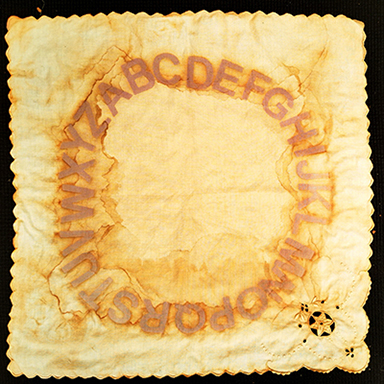
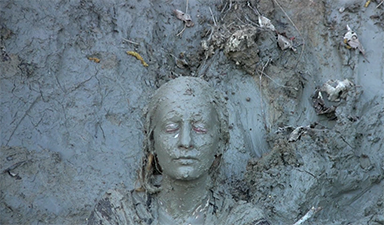




Ritual 2019 Field expeditions |
 |
|
 |
The human relationship with nature is a tenuous one. We are at once a part of the natural world, yet intentionally set apart from it. I am interested in this disconnect; our refusal as a species to admit that we, too, are animals. There is a sense of savagery that comes with being an animal, being wild. We have been taught to become something other, to become domesticated. There is loss in this becoming. Though all experience this (false) dichotomy between humans and nature, the accepted social construction of femininity is much further removed from the nature of the human animal.
|
|
 |
Sharon Stevens, Calgary, Alberta I am a media artist, curator, and community celebrationist. My art practice is externalized as community-based and collaborative projects evidenced by Id Collective, Council of Community Conveyors, Finding the P Spot, and OX A Crash Course on Loving Calgary. These projects along with all the artists mobilized to participate in the Equinox Vigil point to my belief that by working together we can create experiential beauty. In 2012 I initiated and now annually produce Equinox Vigil in Union Cemetery. I bring together artists and Calgarians of every stripe and persuasion in a free, non-denominational event to honour the dead and reflect on the universal experience of death. The result is beautiful, multi-disciplinary, participatory, enchanted and unforgettable. I personally contribute a media art installation called Digital Shrine "Our notes, having been turned simply into light, roll up the screen like credits, a kind of contemporary paper-burning ceremony. Lindsay Sorell writer Equinox Vigil Commemorative book 2017 As a socially-engaged artist I am as likely to be giving a talk at an artist-run centre as leading the charge in a performance/protest piece dressed up as oil-drenched duck. This kind of work is invigorating and exhausting. I find a sense of humour along with embodying creativity is essential for well beings. Finding a balance for restorative solitude is also a life goal. |
|
 |
Death is the only sure, universal thing in this world. Still, it is something most of us only approach with meekness when it is at our own doorstep. We have grieved and cared for our dead for all of history, yet when the time comes for us, we find ourselves paralyzed. We are unsure how to feel, what we’re allowed to feel, and how it looks to others. Despite the myriad of healthy ways and methods grief manifests culturally, spiritually and individually, it is all too easy to rob ourselves of the experience of grief in some form or another for fear to embracing our grief in its entirety. In doing this, we lose out on the valuable realizations of of our own mortality as well. As an artist, I am interested in using digital technology and art therapeutic elements to explore and promote healthy grieving, provide an alternative to end of life anxiety, and find new ways of expressing ritual, and continuing bonds with our deceased. My work investigates intersections of emotional intimacy in conjunction with new digital technologies and internet culture. I am interested in cultural perceptions of death and dying in the digital era, as well as using art to interrogate evolving forms of grieving and mourning rituals perpetuated online and through new forms of media. Though disparate in medium and method, my works aim to use language and symbolism as a vehicle to move through trauma, and grief. In these personal, cathartic and at times, darkly humorous works I explore concepts of loss, ritual, and the healing power of tenderness and honesty. |
|
 |
Sandrine Schaefer, Waltham, MA Using a site-sensitive approach, my work asks how bodies measure time while enduring |
|
 |
In my work I investigate ways to create physical representations of human mentality and |
|
 |
Brad Modlin, Nebraska I live on the lookout for what makes humans human. People experience self-consciousness. Giraffes don’t get embarrassed. Therefore, the feeling of being the isolated, odd-one-out actually connects us to our species. My last book of poems, Everyone at This Party Has Two Names, considers self-consciousness in humorous and serious ways. It explores feeling like the oddball, the only unhip party guest who has just one first name and cannot keep track of everyone else’s two—names they keep switching between as the night progresses. |
|
Field Expeditions 2019 |
|
|
 |
Chantal Lafond, Calgary, AB I am an emerging artist based in Calgary, Alberta, primarily working with traditional fibre techniques such as weaving, knitting and embroidery. My work often includes objects and materials that are conducive to preservation, or protective, nurturing acts. |
|
 |
Judy Duggan-McCormack, Hamilton ON As a textile artist, the work I generate I would articulate as both subjective and observant. I create with a desire to explore and satisfy my artistic needs while incorporating historical and genealogical facts or nuances. I feel a longing to explore, collect, source and sample from events that have taken place through generations of my own family as well as obscurely chronicled narratives of the past. My design plan can either be a 'spark' of inspiration or an observation from another influence, Therefore I remain open until I have researched my thoughts, findings and ideas and my initial project plan may morph between the idea stage and the execution of the art piece. |
|
 |
Combining a vibrant color palette, dense composition, and bold approach with an unapologetic study of mortality, my work exposes the ferocity of nature and the trauma associated with survival. Having been exploring death in my work for several years, I experienced the misfortune of facing my own memento mori in 2018. Recovering from bodily trauma, I returned to my studio with wilting “get well” flower arrangements I received while hospitalized. Not typically interested in painting flowers, I chose the subject in a utilitarian fashion to recharge my practice. Painting these arrangements in decay generated connections between survival, loss, death, memory, and transformation. Incorporating cardboard, window curtains, pillow cases, bed sheets, and vintage printed paper into my paintings, much of my work is best described as 2D assemblages. These discarded materials allow me to build, deconstruct, rip, tear, cut, mold and manipulate forms reflecting the deaths we meet within life. The nuanced surfaces help to define the ravage nature of survival and the forced patterns created from emotional and psychological loss. Living near the Gulf coast of Florida, I have witnessed the devastation of Hurricane Michael. By documenting the ruins of its path I am holding a mirror to life’s fragility and disaster, but also uncovering the portrait of survival. My most recent work Remains layers the imagery of the wilting flowers and the hurricane debris while drawing parallels between crumbling skeletons of houses and an encounter with ravaging illness. Defined by vivaciousness, my work embraces the natural processes of life with honesty and fervor. |
|
 |
Katie Barron, Canmore, Alberta Life is short and made for enjoying. So many of the things that we interact with on a regular basis spark some small form of joy; whether it be a happy memory, a love of a particular colour, or a delicious flavour. By taking the time to fully render these simple objects I get the pleasure of exploring all of the small things that add up to something so simply joyful. Painting realism for me is an act of mindfulness meditation, spending extended hours focusing on the smallest portion of something that creates happiness and teasing apart what exactly it is that I enjoy so deeply. In my work I draw inspiration from both everyday modern objects but also from the old masters in the form of capturing dramatic lighting to build an emotional connection with the viewer. By contrasting colourful, joyful objects with deep shadows I invite the viewer to create an emotional connection as well as see these objects on their own, outside of the influence of anything |
|
 |
Kristine Thompson, Baton Rouge, LA My creative work examines social and emotional responses to death, how we mourn, and the memorial properties attached to particular objects and spaces as we grieve. My work also increasingly considers how photographs circulate—particularly photographs of death or mourning—and how a photographic image might elicit empathy. |
|
 |
Jane Ross, London UK I am a London-based photographer, interested in discovering and documenting the overlooked, discarded and forgotten, and exploring how photography can help us capture memory, retrieve the past, commemorate the dead and deal with loss. An interest in how we respond and relate to death informs my photographic practice. London is running out of space to bury its dead. Some cemeteries intend re-using specific graves unless they receive notification from relatives not to do so. In my recent, ongoing project in Brompton Cemetery – one of London’s ‘Magnificent Seven’ Victorian garden cemeteries – I imagine the past lives and lost souls resting in the graves that will soon be disturbed. Many of the graves are unmarked, decaying and their inscriptions worn away. The lives of those buried there are unknown but they are somehow marked here forever. I make my images in the cemetery with found photos, then layer and multiexpose in the camera -- letting the play of light and shadow evoke the souls and spirits of the deceased. I graduated with a Masters in Photojournalism and Documentary Photography from the London College of Communications (University of the Arts) in 2015 and although my day job in communications does involve travel and documentary photography, I spend most of my free time on personal photography projects in London and Italy, where I lived for nearly 20 years. |
|
2018 Field Expeditions |
 |
|
 |
Katrina Vera Wong, Vancouver When people ask what I do, I tell them I make flowers. And I call them Frankenflora . |
|
 |
Yannick De Serre, Montreal Yannick De Serre’s work is today strongly influenced by his stay in northern Quebec. Always refined, his different series testifies of the emptiness, death, calmness and the northern landscapes; through a minimalist aestheticism. |
|
 |
Ashley J. Ortiz-Diaz, Florida My concern is to confront the viewer with a scene that is serene, yet unsettled, in order to incite a reevaluation of a proposed reality. Removing spatial planes from perspectival references (reality) allows the mind to create its own reference points. When that plane does not logically align with the edge of the picture and is furthermore made dimensional or dynamic according to unknown laws, the simple and familiar is made uncanny and other-worldly. Evoking a hole, a thin veil or perhaps a bed, the plane(s) subtly transforms within the soft grey atmospheric surroundings. The work is a representation of what it is to confront and contemplate mortality.
|
|
 |
Erin Williamson, Toronto, Ontario I like to work with found objects and exploit the colors and textures that are inherent to the materials. All of the materials I work with are chosen carefully to depict a sense of safety and struggle relating to the human body and the comfort it provides us and limits us to. I want to create a sense of nostalgia for a safe space provided by the physical womb as well as the struggle that comes with coping with our inevitable expulsion from this ephemeral place. Along with that I also portray a sense of self-repulsion that comes with my own personal constant need for comfort and validation provided by others. My favorite material to work with is nylon and I incorporate in all of my work. I appreciate its translucent nature and the neutral tone of the material as well as how it can stretch and tear to create a sense of struggle. I like the color pink because it allows me to abstractly reference the human body and its internal organs, specifically the uterus, through man-made materials. This is why I manipulate rigid found objects into more organic shapes to create a juxtaposition between what is natural and what is not. I see all the different objects as individual pieces with unique identities working together to create a larger entity and give the viewer a sense of security. I also appreciate the idea of pink being considered a “feminine” color because I want to exploit this binary idea and express a sort of delicacy in my work through that. For me this delicacy represents something that is inherent to our being as humans who experience emotion in unique ways. My sculptures are very fragile and easy to take down. In this way they are very ephemeral and once taken apart can never be reassembled in the same way. The moment we are born we are vulnerable, pushed out of a space that kept us safe and in which I constantly long to seek the same sort of comfort and safety found within that space. |
|
 |
Alivia Magana, Albuquerque Through the medium of photography, Alivia Magana explores topics related to the |
|